Naksan Temple
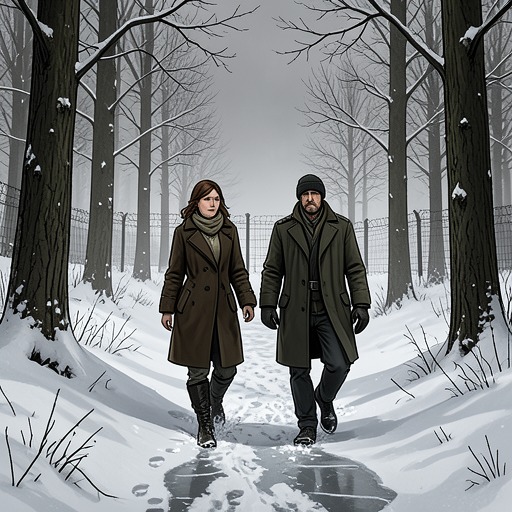
Winter in SokchoNaksan Temple is a cliffside sanctuary above the beaches near Sokcho, where the novel brings together religious imagery, a close encounter between the narrator and Yan Kerrand, and the unresolved presence of war. Its statues and seasonal associations offer a language of transition, while rain, barbed wire, bunkers, and an icicle falling from the roof keep the surrounding landscape insistently physical and unsettled.
Setting and Return Visit
The narrator accompanies Kerrand to Naksan Temple on a return visit. He had gone there once near the beginning of his stay and now wants to buy more incense. They travel by bus along the coast, with only two hours available before the narrator must return to make dinner. She has not told Old Park about the outing. The practical limits of the visit—a bus journey, a brief window of time, and a household obligation—place this religious site within the ordinary routines of life in Sokcho rather than outside them.
On the way, Kerrand is absorbed in a book he brought from his suitcase. The narrator tries to read over his shoulder, then asks him to read to her. Although he says he does not like reading aloud, he does so carefully after she closes her eyes. She attends less to the difficult words than to the sound of his voice, which seems distant to her, as if coming from a body on the other side of the world. The journey therefore begins with a form of intimacy made through listening, but also with an awareness of distance between them.
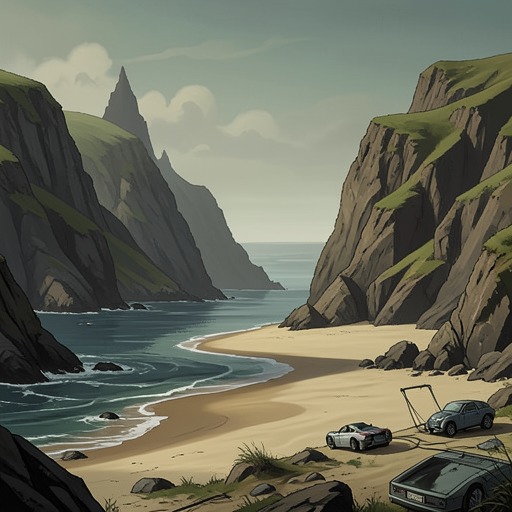
The temple is built into cliffs above the beaches. When the pair arrive, the nuns are meditating, so they have to wait. Fine rain turns into a downpour, driving them beneath an overhanging roof. Chanting reaches them through the walls, its rough sound echoing across the courtyard. The weather and the wait shape the visit: instead of moving directly into a religious service, the visitors remain outside, sheltered at the threshold and listening.
Figures and the Turning Seasons
The courtyard is dotted with statuettes of dragons, snakes, phoenixes, tigers, and tortoises. The narrator recalls a school trip on which a nun explained that each animal corresponds to a different season. Kerrand counts five figures, then listens as the narrator describes their relationships: the snake acts as a pivot between seasons; the tortoise guards winter; and, in spring, the dragon must find the snake before the tortoise will let it pass. Seasonal change is presented not as an effortless passage but as a sequence governed by guardians, dependencies, and permission.
Kerrand studies this account through the figures themselves. He kneels before a tortoise, touches its shell, examines the fold of its neck, and traces the joint attaching the figure to its wooden base. He remains there motionless for a long time. The attention is both artistic and tactile: he looks closely at how the image is constructed, as well as at what it represents. In a story preoccupied with winter and suspension, the tortoise’s role as winter’s guardian gives the seasonal explanation particular resonance, while the snake and dragon make the prospect of transition imaginable without making it immediate.
The incense connects the temple to Kerrand’s room as well as to this visit. Earlier, the narrator finds a packet of incense from Naksan Temple beside his incense burner. His wish to buy more on the return journey makes the object a recurring trace of his earlier visit and a reason to come back. The temple is thus not only a dramatic setting: something taken from it continues to occupy a small, visible place in his temporary home.
The Coast, War, and the Border
From the temple grounds, a pagoda appears on a distant bluff, partly merging with the mist. The pair run toward it through the rain. Beyond the surrounding beaches, barbed wire marks the coast, while bunkers recur at regular intervals with sub-machine guns protruding from their openings. The narrator points these out to Kerrand. The landscape joins a sacred building to military infrastructure without allowing either to disappear from view: the pagoda rises through mist, but the armed installations remain part of the same coastal scene.
Their conversation turns on how beaches hold different histories. Kerrand contrasts the beaches of France with the more threatening Korean coast and says that he prefers the colder, emptier beaches of Normandy, which bear their own scars from war. The narrator objects to treating those histories as equivalent. In her account, France’s scars belong to the past, whereas Korean beaches remain suspended in a war that has not reached an ending people can trust. Hotels and neon signs make the shore look like a developed seaside destination, but for her that surface feels false and fragile: the country is living in limbo, in a winter that never ends.
She makes the danger concrete by recalling that, the previous summer, a tourist from Seoul was shot by a North Korean soldier while swimming in the sea. The tourist had not realized she had crossed the border. The incident gives the coastline’s wire and military presence a human consequence: the boundary is not merely visible scenery or a subject of historical display, but a division that can be crossed unknowingly and with fatal results. At Naksan Temple, a discussion prompted by the view becomes a disagreement about whether war can be safely relegated to the past.
Encounter and Narrative Significance
After the narrator speaks about the precariousness of life in Korea, she turns back toward the temple. Kerrand comes to stand beside her. Her hands are shaking, and she looks straight ahead. As they speak, he grabs her by the waist and pulls her back from the spot where she has been standing; an icicle breaks off above her and shatters on the ground. He keeps his hand at her waist as the nuns open the doors and the smell of incense drifts into the rain. The near accident brings bodily danger into the scene at the same time that their conversation has made political danger explicit.
The temple’s meaning therefore rests in its conjunctions rather than in a simple escape from the world. Meditation takes place behind walls, but its chanting carries into a rain-filled courtyard; seasonal figures promise movement, but the narrator describes a country caught in an unfinished conflict; incense links sacred space to Kerrand’s room, while the surrounding coast remains guarded. The visit gives the pair a setting in which to look, listen, and speak across differences in national memory, without resolving those differences. Naksan Temple stands above the beaches, but it does not stand apart from the histories and risks that shape them.